
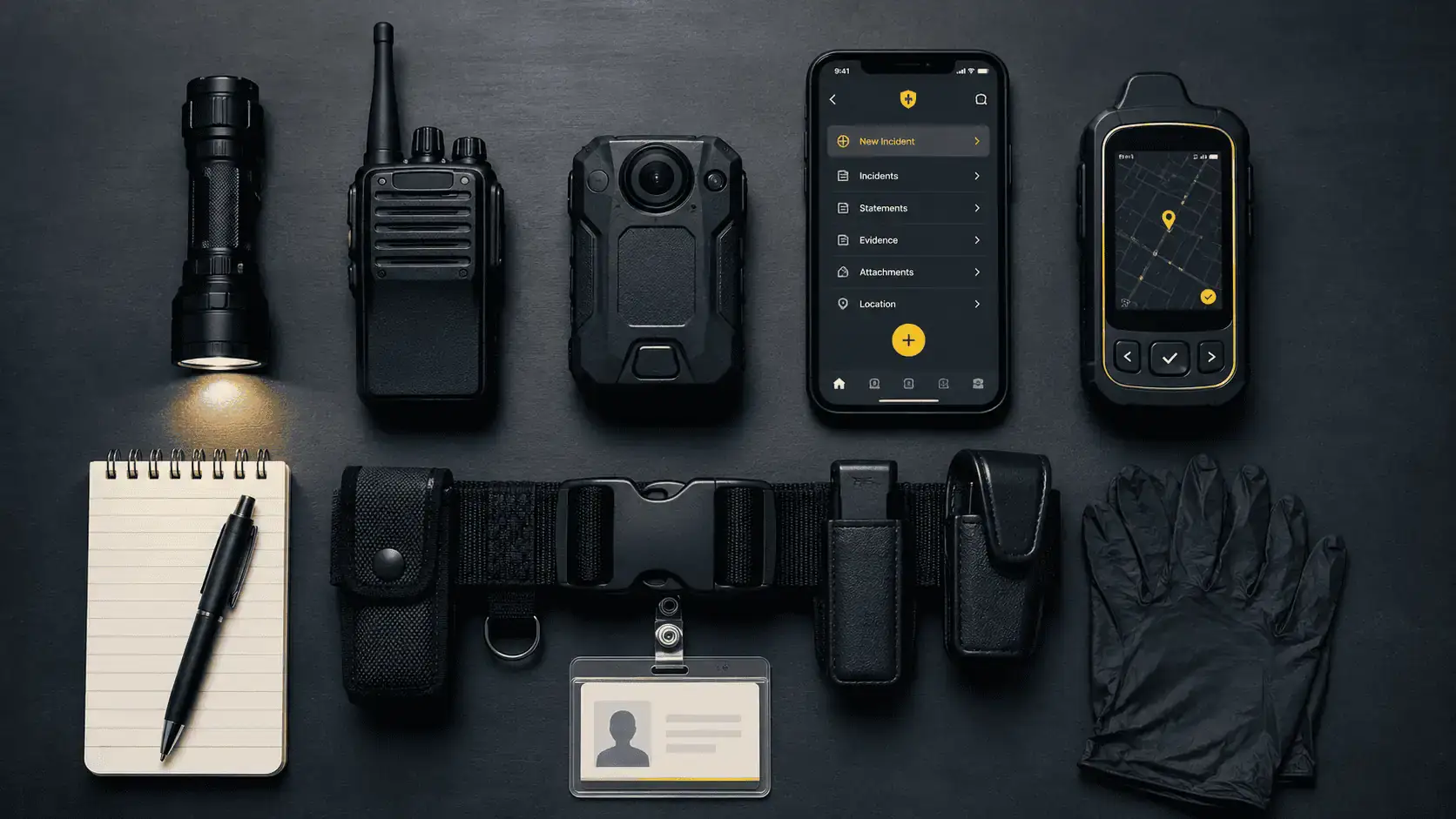
A security guard is only as effective as the tools they carry. The right equipment is what separates a visible deterrent from a costly liability.
It determines whether an officer can see into a dark stairwell, call for backup before a situation escalates, document an incident accurately, and respond when seconds matter. And the kit has changed. The job that once meant a flashlight, a radio, and a notepad now runs on body-worn cameras, GPS patrol verification, and mobile incident reporting.
“People picture a flashlight and a uniform, but the equipment is what makes the work defensible. When something goes wrong at two in the morning, what protects the client, and the officer, is whether the gear was there, worked, and was used correctly.” – Amanda DeAlmeida, Executive Vice President, Building Security Services
Below is the complete security guard tools and equipment list: what every officer carries, the technology behind a modern post, the gear that changes by environment, and the rules that govern it in New York and New Jersey.
Everyday essentials: what every guard carries
Regardless of the site, a handful of items form the baseline of any officer’s kit. These are the tools used on every shift, on every post.

Duty belt
The duty belt is the organizing hub for everything an officer carries on their person. A well-configured belt keeps a flashlight, radio, notepad, and any authorized self-defense tools within immediate reach, distributing weight evenly so a guard can stand or patrol for a full shift without strain. How a belt is loaded says a lot about how a post is run. Disorganized gear is slow gear.
Uniform, badge, and ID
A clean, branded uniform is itself a piece of equipment. It establishes authority, makes the officer easy to find in an emergency, and signals to anyone on site that the property is actively monitored, a deterrent before a word is spoken. A visible badge and photo ID confirm the officer is legitimate and, in licensed roles, that they are authorized to be there.
Flashlight
A flashlight remains one of the most-used tools on any post. Guards rely on it whenever lighting is insufficient: dark stairwells, parking structures, loading docks, or exterior perimeters at night. There are three common types:
- Tactical flashlight: compact and high-output, bright enough to illuminate a perimeter and, at close range, to momentarily disorient a hostile individual. For an unarmed officer, a high-lumen light doubles as a non-lethal defensive tool.
- Hands-free / headlamp: frees both hands for writing reports, operating doors, or rendering aid during a patrol.
- Penlight: small enough to clip to a uniform for ID checks, document inspection, and close work.
Pen and notepad
Even in a digital era, a pen and pad are standard. Officers use them to capture details in the moment, like time stamps, vehicle descriptions, names, and the sequence of an incident, before memory fades. Those notes often become the backbone of a formal incident report.
Communication equipment
An officer who cannot communicate is an officer working blind. Reliable communication is what turns a single guard into part of a coordinated team and connects a post to management and emergency services.
- Two-way radio: the workhorse of site communication. Radios are instant, don’t depend on cellular coverage, and let a team coordinate across a large property in real time.
- Earpiece and shoulder microphone: keep communication discreet and hands-free, which matters at front desks, events, and any post where a guard needs to listen without broadcasting.
- Mobile phone: for contacting management, calling emergency services directly, and running the apps that now handle scheduling and reporting.
On larger or multi-officer accounts, radios and phones increasingly feed into the same software platform that handles patrol tracking and reporting, covered in the next section.
Self-defense and defensive gear
Defensive equipment exists to protect the officer and de-escalate or contain a threat, never to escalate one. What an officer is permitted to carry depends on their license type and the state they work in.

- Pepper spray (OC spray): a common non-lethal option for creating distance from an aggressive individual.
- Baton: used to subdue or control a combative person at close range; carries stricter authorization requirements than spray.
- Handcuffs: for detaining an individual until law enforcement arrives, where the officer’s role and training permit detention.
- Body armor / protective vest: standard for armed officers and high-risk posts.
- Protective gloves: guard against sharps, contamination, and injury during searches or first aid.
“In New York and New Jersey, you can’t just hand an officer a baton and a can of pepper spray and put them on a post. The defensive tools an officer carries have to match their license, their training, and the client’s risk profile. We build the kit around what’s actually authorized, not what looks impressive.” – Craig Battle, New York Branch Manager, Building Security Services
The line between authorized and unauthorized gear is set by state licensing. New York requires specific training and registration before an officer can carry certain equipment or work armed. See our guide to the New York State security guard license. The difference in equipment between unarmed and armed officers is one of the clearest reasons to match the service to the site.
Modern security technology
This is where the job has changed most. The tools below didn’t exist on a standard post a decade ago; today they are what clients expect and what makes guard work accountable and verifiable.

Body-worn cameras
Body cameras record an officer’s shift, creating an objective record of interactions. They protect everyone involved: they deter bad behavior from the public, document an officer’s conduct, and produce evidence that holds up far better than a written account alone.
Mobile incident-reporting apps
Reporting has moved off the clipboard. Officers now log incidents on a phone or tablet with time stamps, photos, and GPS location attached automatically. Reports reach management in real time instead of at the end of a shift, and nothing gets lost between the post and the office.
GPS guard-tour and patrol software
Guard-tour systems verify that patrols actually happen. An officer scans checkpoints (via NFC tags, QR codes, or GPS) as they move through a property, producing a time-stamped record of every round. Clients get proof of service; managers get alerts when a checkpoint is missed. It’s the difference between trusting that a patrol happened and knowing it did. See what officers actually check on a round in our guide to what guards look for on patrol.
Mobile CCTV access
Guards increasingly monitor live camera feeds from a phone or central station, extending their effective reach far beyond what one officer can physically watch. This pairs on-site presence with remote oversight across an entire site.
“The technology doesn’t replace the officer — it makes the officer’s work provable. When a property manager asks whether the overnight patrols happened, I can show them every checkpoint scan with a time stamp. That accountability is what earns long-term contracts.” – Amanda DeAlmeida, Executive Vice President, Building Security Services
Emergency and safety gear
Officers are often first on the scene of a medical event, fire, or accident, sometimes minutes ahead of responders. A baseline of emergency equipment lets them act instead of waiting.
- First aid / trauma kit: bandages, gloves, and bleeding-control supplies for stabilizing an injury until EMS arrives.
- Whistle or audible alarm: to summon attention or signal an evacuation.
- High-visibility vest: for traffic control, parking patrols, and low-light exterior work.
Equipment by environment
The core kit stays consistent, but the emphasis shifts with the assignment. A construction-site officer and a hospital lobby officer carry different priorities. This is where matching the gear to the job matters most.
| Environment | Equipment emphasis |
|---|---|
| Construction sites | High-output flashlights, GPS patrol verification for large perimeters, high-visibility gear, weather-rated equipment |
| Retail | Body cameras, discreet earpieces, mobile incident reporting, radio coordination across a sales floor |
| Events & crowd control | Two-way radios, high-visibility apparel, metal-detection wands, clear team communication |
| Hospitals & healthcare | Body cameras, de-escalation focus, PPE and gloves, discreet communication |
| Residential & commercial buildings | Guard-tour checkpoints, access-control familiarity, professional uniform for a concierge-style presence |
Patrol-based assignments lean especially hard on tour verification and mobility. See our mobile patrol services for how that gear comes together in the field.
Caring for security equipment
Gear that fails on shift is worse than no gear, because it creates false confidence. A simple maintenance routine keeps a kit reliable:
- Test flashlight and radio batteries at the start of every shift.
- Inspect defensive tools and body cameras for damage or wear.
- Confirm reporting apps and guard-tour devices are charged and synced.
- Log and replace any item that’s expired, damaged, or unreliable.
At Building Security Services, equipment readiness is part of the post, not an afterthought. It’s one of the operational standards behind the everyday duties of a security guard.
The people behind the equipment
Equipment matters, but it’s only as good as the company standing behind it. Security guards remain one of the largest protective-service workforces in the country: the U.S. Bureau of Labor Statistics counts 1,272,400 security guards employed nationally, with a median annual wage of $38,370 as of May 2024 (U.S. Bureau of Labor Statistics, 2024). You can see more workforce data on our security guard employment statistics page.
“In forty years, the gear has gone from a flashlight and a punch clock to body cameras and GPS-verified patrols. What hasn’t changed is that the equipment only works in the hands of a well-trained, well-supervised officer. We invest in both.” – Joseph Ferdinando, Founder, Building Security Services
For more than 40 years, this women-led, BOMA-member firm has equipped and trained officers across New York and New Jersey to that standard.
Frequently asked questions
What equipment does a security guard carry?
Most security guards carry a duty belt, flashlight, two-way radio, notepad, ID badge, and a phone with a reporting app. Many also carry a body-worn camera, and, depending on license and assignment, authorized self-defense tools such as pepper spray, a baton, or handcuffs.
What is in a security guard’s duty belt?
A typical duty belt holds a flashlight, radio, notepad, gloves, and any authorized self-defense equipment. The belt keeps essential gear within immediate reach and distributes weight so an officer can work a full shift comfortably.
Can security guards carry pepper spray and batons in New York and New Jersey?
It depends on the officer’s license type and training. Both states regulate which defensive tools an officer may carry, and certain equipment requires specific certification or armed-guard registration. A licensed firm matches each officer’s gear to what their credentials authorize.
Do unarmed security guards carry weapons?
Unarmed officers do not carry firearms. They may carry non-lethal tools such as a high-lumen flashlight, and in some cases pepper spray, where their license permits. Their effectiveness comes from presence, observation, communication, and rapid coordination rather than weaponry.
What technology do modern security guards use?
Modern officers use body-worn cameras, mobile incident-reporting apps, GPS-based guard-tour systems that verify patrols, and mobile access to live CCTV feeds. This technology creates a time-stamped, verifiable record of the work performed.
Who provides a security guard’s equipment?
A professional security company typically provides and maintains the core equipment (uniforms, radios, body cameras, and reporting tools) and ensures every item meets the licensing requirements for the officer’s role and state.
Equip your property with the right protection
The best equipment list in the world means nothing without trained officers and the supervision to back them up. Building Security Services has spent more than 40 years equipping, training, and deploying security professionals across New York and New Jersey, with the technology and accountability today’s properties expect.
Request a free quote or call (973) 414-1111 to talk through the right security solution for your site.


