
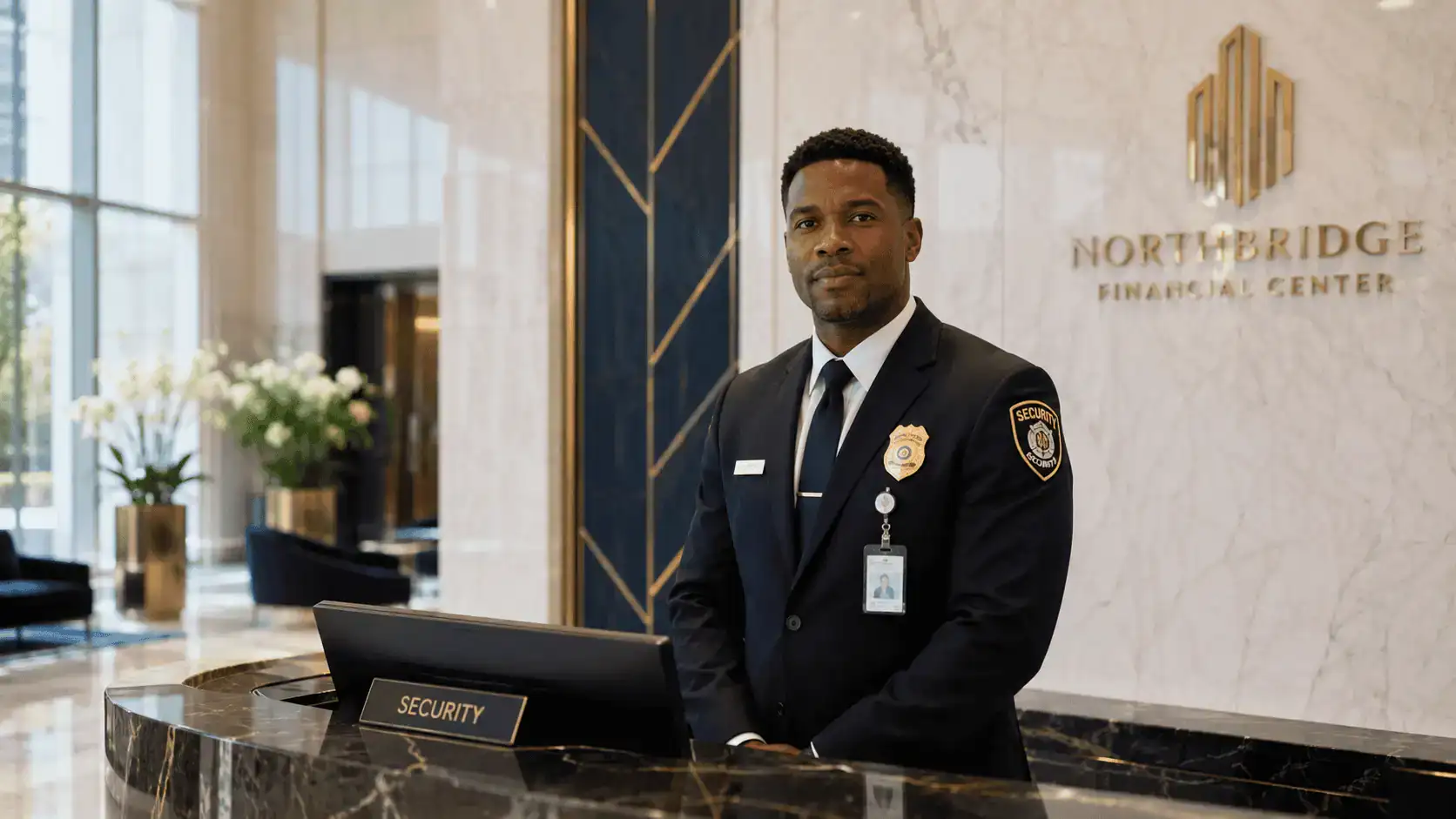
Security guards are the people behind every secured lobby, patrolled parking lot, monitored loading dock, and staffed front desk. Their work is the difference between a building that runs smoothly and one that becomes a target.
Yet most people, including the property managers and facilities directors who hire them, don’t have a clear picture of what a security guard actually does day to day, what training they’re required to complete, or how their duties shift depending on the site.
This guide covers it all: core duties, the skills that separate good guards from great ones, equipment guards use on shift, licensing requirements in New York and New Jersey, specialized roles like fire safety directors, and how duties vary across industries.

It draws on more than 40 years of operational experience from Building Security Services, a women-led security firm staffing posts across NYC and NJ.
What Does a Security Guard Do?
A security guard’s job is to protect people, property, and assets from threats: theft, vandalism, unauthorized access, medical emergencies, fire, and disorder. They are the visible deterrent that stops most problems before they happen, and the trained first responder when something does.
The role is broader than most assume. A guard at a Class A office tower in Midtown spends most of their shift on access control and visitor management. A guard on a Brooklyn construction site spends it on patrol and equipment monitoring. A fire safety director in a high-rise spends it running drills and managing evacuation procedures. Same title, different work.
Key stat: The Bureau of Labor Statistics projects 33,500 openings for security guards each year through 2033, driven by industry growth and turnover replacement (BLS Occupational Outlook Handbook, 2024).
Core Duties of Security Guards
Every guard post is built around a written set of post orders, the specific instructions for that site. But the underlying duty categories are consistent across nearly every assignment.
Observation and Reporting
Observation is the foundational duty. Guards scan for anything out of place: an unfamiliar vehicle in a restricted lot, a door propped open, a person loitering near a back entrance, equipment that’s been moved. Most security incidents are preceded by small anomalies that an attentive guard catches before they escalate.
Every shift produces a written report. Daily activity logs capture routine observations; incident reports document anything requiring action. Accurate, time-stamped documentation matters legally. It’s the record that holds up in court, insurance claims, and internal investigations. For a worked example, see our security guard incident report checklist.
Access Control and Visitor Management
Controlling who enters and leaves a property is one of the highest-volume duties. Guards verify employee IDs, issue visitor badges, log contractor arrivals, check delivery manifests, and turn away unauthorized individuals. In larger buildings this is paired with electronic access control systems. Guards monitor the panel and respond to denied entries, tailgating, and forced-door alarms.
Visible Deterrence and Crime Prevention
A uniformed presence reduces opportunistic crime before it happens. Commercial property loss data shows visible security personnel cut shoplifting, trespass, and vandalism rates compared to unstaffed sites. The guard doesn’t need to act. Being seen is the deterrent.
Crowd Control and Maintaining Order
At events, retail stores during peak hours, building lobbies during shift changes, and emergency evacuations, guards manage flow and prevent crowd-related incidents. The skill is reading a crowd: spotting agitation, intoxication, or escalating conflict early and intervening before it spreads.
Emergency Response
Guards are usually the first on scene for medical emergencies, fires, intrusions, and severe weather. Their job is to stabilize the situation, administer first aid or CPR, evacuate occupants, contain the area, and hand off to professional responders. Many BSS guards also serve as fire safety directors in NYC buildings where that role is required.
Communication with Law Enforcement
When an incident exceeds the guard’s authority (an assault, a confirmed break-in, a weapons sighting), the guard calls local police or fire and provides clear, factual reporting on arrival. The handoff matters. A calm guard with a coherent timeline saves responders critical minutes.
Tools and Equipment Guards Use
Guards rely on equipment to do the job. Standard kit includes:
- Two-way radios, the primary communication tool between guards, supervisors, and the central station
- Body-worn cameras, increasingly standard for incident documentation and liability protection
- CCTV monitoring stations, where guards rotate between foot patrol and camera duty on most multi-guard posts
- Metal detectors and X-ray equipment, at courthouses, stadiums, and high-security sites
- Access control panels, for credential verification and door management
- Incident-report software, which has largely replaced paper logs
- Flashlights, batons, and (on armed posts) firearms, used only when authorized and trained
For a deeper breakdown, see our security guard tools and equipment list.
Risk Assessment
Experienced guards continuously assess their environment, identifying weak points in physical security, foot traffic patterns that create vulnerability, and after-hours blind spots. On many BSS contracts, lead guards contribute observations to the formal risk assessment used to set post orders and staffing levels.
How Security Guard Duties Vary by Industry
The job description on paper is similar across sites. The day looks different.

Commercial Real Estate
In Class A office buildings, the focus is access control, visitor management, and tenant relations. Guards staff lobbies, manage loading docks, and coordinate with building management on contractor access. Professional appearance and discretion are non-negotiable. See commercial real estate security.
Residential Buildings
Residential guards, often working as concierges or doormen, combine security with hospitality. They know the residents by name, screen visitors and deliveries, control package rooms, and serve as the building’s after-hours point of contact. See concierge and doorman services.
Healthcare
Hospital security is among the most demanding posts in the industry. Guards de-escalate combative patients, secure the emergency department, manage behavioral health holds, and respond to infant abduction codes. Healthcare guards typically need additional training in HIPAA, restraint protocols, and crisis intervention. See hospital security services.
Retail
Retail guards focus on loss prevention, customer-facing presence, and incident documentation. Plainclothes loss-prevention officers work alongside uniformed deterrent posts. See retail security services.
Construction Sites
Construction security is about protecting expensive equipment and materials after hours. Copper, tools, fuel, and machinery are high-theft targets. Patrol routes, perimeter checks, and remote video monitoring are the core duties. See construction security services.
Education
School and college guards balance student safety with an approachable presence. Duties include access control, after-hours patrol, event coverage, and lockdown response. See K-12 security and college security.
Events
Event security blends crowd control, access verification (tickets, credentials, VIP zones), and rapid emergency response in fluid environments. Guard counts scale to crowd size. See event security services.
“The biggest mistake clients make is assuming a guard is a guard. The right guard for a Midtown office lobby would struggle on a Newark construction site, and vice versa. Matching the person to the post is half the work.” – Amanda DeAlmeida, Executive VP, Building Security Services
Key Skills Security Guards Need
The technical duties are learnable. The skills that separate average guards from professionals are mostly interpersonal and cognitive.
Observation
The ability to scan an environment, notice what’s changed, and identify what doesn’t belong. This is trainable but plateaus quickly. The best observers are wired for it.
Judgment
Deciding when to call police, when to intervene physically, when to let a situation resolve itself, and when to escalate to a supervisor. Bad judgment creates more problems than the original incident.
Communication
Clear, calm, factual reporting to residents, tenants, dispatchers, and responding officers. Written reports must be complete and unambiguous. See effective communication skills for security guards.
De-escalation and Conflict Resolution
The vast majority of confrontations are resolved verbally. Guards trained in de-escalation (controlled tone, body language, active listening, offering off-ramps) handle situations that untrained guards turn into incidents.
Customer Service
Most guard interactions are with employees, tenants, and visitors, not threats. A guard who is courteous, helpful, and remembers names builds the relationships that make the security function work. In residential and hospitality posts, this is the job.
Ethics and Integrity
Guards are entrusted with access, information, and authority. Honesty, accountability, and respect for the chain of command are non-negotiable. A single ethics breach can compromise an entire account.
Physical Fitness
Patrol shifts cover miles. Standing posts demand stamina. Emergency response requires the physical capacity to act. BSS maintains fitness expectations appropriate to each post type. See security guard fitness.
Technology Proficiency
Guards operate access control panels, CCTV systems, digital incident-report platforms, badge printers, and visitor management software. Comfort with technology is now a baseline requirement, not a bonus skill.
“Forty years in this business, and the one thing that’s never changed is what makes a great guard: presence of mind. Equipment, certifications, software, all of it matters. But when something goes wrong at 2 a.m., what saves the day is a person who can think clearly under pressure.” – Joseph Ferdinando, Founder, Building Security Services
For more on what defines a strong officer, see our breakdown of skills and qualities of security officers.
Requirements to Become a Security Guard
Becoming a licensed guard is a regulated process. Requirements vary by state, but the core path is consistent.
Education
A high school diploma or GED is the standard minimum. Some specialized posts (corporate security, executive protection, federal contracts) prefer or require post-secondary coursework in criminal justice or related fields.
Licensing and Certification
Every state regulates security guards differently. The two BSS operates in:
New York. Guards are licensed under Article 7-A of the General Business Law, administered by the Department of State. Required training:
- 8-hour Pre-Assignment Training, completed before working any post
- 16-hour On-the-Job Training, completed within 90 days of starting
- 8-hour Annual In-Service Training, every year the license is active
- 47-hour Firearms Training, required additionally for armed guard registration
For full detail, see our guide to the NYS security guard license.
New Jersey. Guards must complete SORA (Security Officer Registration Act) certification, administered by the New Jersey State Police. SORA requires a 24-hour training program covering ethics, communication, emergency response, and legal authority, followed by a state exam.
Beyond state licenses, experienced guards often pursue professional credentials from ASIS International:
- CPP (Certified Protection Professional), the board-level security management credential
- PSP (Physical Security Professional), physical security systems specialization
- APP (Associate Protection Professional), entry-level professional credential
- PCI (Professional Certified Investigator), investigations specialization
- CHPA (Certified Healthcare Protection Administrator), hospital security leadership
- CFPS (Certified Fire Protection Specialist), fire and life safety expertise
Background Checks
Every applicant in NY and NJ submits to fingerprinting and a state and FBI criminal history check. Disqualifying convictions vary by state but generally include felonies involving violence, theft, or moral turpitude. Applicants must also be at least 18 years old (21 for armed registration), legally authorized to work in the United States, and able to read and write English.
Training
State-mandated hours are the floor, not the ceiling. Good security firms add post-specific training before deploying any guard: site orientation, post orders walkthrough, emergency procedures specific to that property, and shadow shifts with a senior officer. BSS pairs every new hire with an experienced guard for their first shifts on any new account.
Armed vs. Unarmed Security Guards
The distinction is one of the most common questions clients ask. Most BSS posts are unarmed. The visible presence, observation, and reporting capabilities are what most properties actually need. Armed guards are deployed where the risk profile, asset value, or regulatory environment specifically warrants firearms.
Armed registration adds significant training (in NY, the 47-hour firearms course plus ongoing qualification), higher insurance costs, and stricter post-order discipline. The choice should be driven by a documented threat assessment, not by default. For a detailed comparison, see unarmed vs. armed security guards.
Specialized Security Roles in NY and NJ
Beyond standard guard posts, several specialized roles serve specific regulatory and operational needs across the region.
Fire Safety Directors and Fire Watch (NYC)
New York City requires certified Fire Life Safety Directors (FLSDs) in most high-rise commercial and residential buildings. FLSDs are FDNY-certified, run building fire safety plans, coordinate evacuations, and staff the fire command station during alarms.
Separately, fire watch guards are required when fire safety systems are impaired (during construction, after a system failure, or during hot work) and provide continuous patrol until the system is restored.

Concierge and Front Desk Security
In residential and hospitality settings, the concierge is the security function: visitor screening, package management, resident relations, after-hours access control. See concierge and doorman services.
Mobile Patrol
For sites that don’t justify a full-time post (small commercial properties, multi-building portfolios, construction sites), mobile patrol units provide scheduled and randomized checks. See patrol services.
Loss Prevention Officers
Plainclothes officers focused on theft detection and apprehension in retail environments. See NYC loss prevention officers.
“The FLSD role is unique to New York. We built our fire safety practice because clients couldn’t find one provider who handled both the guard force and the FDNY-certified roles. After 40 years here, we know how this city’s regulations actually work. That’s not something a national vendor can replicate.” – Joseph Ferdinando, Founder, Building Security Services
Security Guard Salary and Job Outlook
Security guard compensation varies widely by post type, geography, and shift differential.
Key stat: The median annual wage for security guards in the U.S. was $37,070 in May 2023 (BLS, 2024). NYC guards earn meaningfully more. See NYC security guard wage law 2026.
Employment is projected to grow about as fast as the average for all occupations through 2033, with roughly 33,500 openings annually. Armed posts, specialized roles (FLSD, healthcare, executive protection), and supervisory positions pay above the median. For full context, see our security guard income breakdown and security guard employment statistics.
Frequently Asked Questions
What are the main duties of a security guard?
The core duties are observation and reporting, access control, visible deterrence, crowd control, emergency response, and communication with law enforcement. Specific tasks depend on the post. A hospital guard’s day looks very different from a construction site guard’s.
What skills do security guards need?
The most important skills are observation, judgment, communication, de-escalation, customer service, ethics, physical fitness, and technology proficiency. Technical skills are trainable; judgment and interpersonal ability are harder to teach.
What training is required to become a security guard in New York?
New York requires 8 hours of pre-assignment training, 16 hours of on-the-job training within 90 days of starting, and 8 hours of annual in-service training under Article 7-A. Armed registration requires an additional 47-hour firearms course and ongoing qualification.
What training is required in New Jersey?
New Jersey requires SORA (Security Officer Registration Act) certification, which includes a 24-hour training program covering ethics, communication, emergency response, and legal authority, followed by a state exam administered by the New Jersey State Police.
What makes a good security guard?
Presence of mind under pressure is the single most defining trait. Combine that with strong observation, clear communication, sound judgment, and the discipline to follow post orders consistently, and you have a guard who clients ask for by name.
Who does a security guard report to?
Day to day, guards report to a site supervisor or shift lead at their post. The supervisor reports to an account manager at the security firm, who serves as the primary point of contact for the client. Most firms also maintain a 24/7 dispatch center for emergencies.
Do specialized security roles need extra qualifications?
Yes. Armed guards need firearms certification, FLSDs need FDNY certification, healthcare guards typically need crisis intervention and HIPAA training, and supervisory roles often require professional credentials like ASIS CPP or PSP.
Can security guards detain or arrest people?
Guards have the same authority as any private citizen to perform a citizen’s arrest for crimes committed in their presence, but detention authority is limited and varies by state. For a full legal breakdown, see can security guards detain you.
What’s the difference between armed and unarmed guards?
Armed guards carry firearms and are deployed in higher-risk environments. They require significantly more training, licensing, and insurance. Most commercial posts use unarmed guards because visible presence and reporting are sufficient. See unarmed vs. armed.
Professional Security Services from BSS
Building Security Services has staffed security posts across New York and New Jersey for more than 40 years. We’re a women-led firm and the security provider for commercial, residential, healthcare, retail, and construction clients across the region. Whether you need unarmed guards, armed officers, FLSDs, fire watch coverage, mobile patrol, or a full security program tailored to your property, we can build it.
Request a free quote. Tell us about your property and we’ll respond within one business day.


