
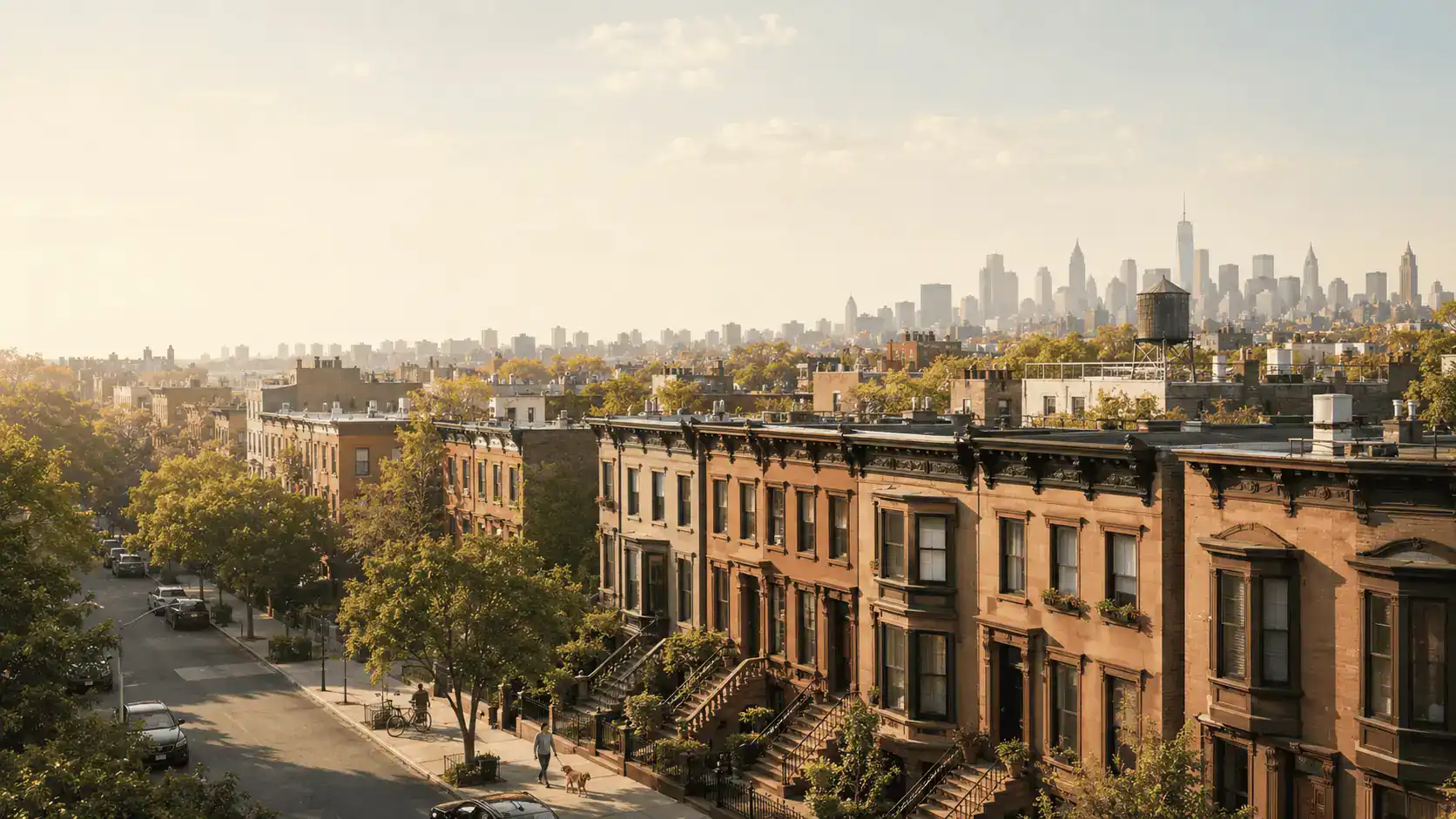
Brooklyn is not one place. It’s more than 2.6 million people spread across dozens of neighborhoods that look, feel, and behave nothing alike, which is exactly why a single answer to “is Brooklyn safe?” tells you almost nothing. The borough that contains a quiet, tree-lined block in Bay Ridge also contains a dense commercial corridor twelve miles away, and the gap between them is enormous.

This guide breaks down the safest neighborhoods in Brooklyn for 2026, using NYPD crime data and neighborhood-level statistics rather than reputation or rent prices. It’s written from the perspective of a company that has spent four decades securing residential and commercial buildings across the borough.
So alongside the rankings, you’ll find a practical look at what actually makes a neighborhood safe, and what residents, property owners, and businesses can do about it. If you want the other side of the picture, our companion guide covers the most dangerous neighborhoods in NYC.
How We Measure Brooklyn Safety
“Safe” is only meaningful when it’s tied to data. For this guide, neighborhood rankings draw on two sources: NYPD CompStat figures, which track major crimes by police precinct, and neighborhood-level crime rates expressed per 1,000 residents so areas of different sizes can be compared fairly.
Across Brooklyn as a whole, the crime rate sits around 26 incidents per 1,000 residents in a typical year, earning the borough a roughly middle-of-the-pack national safety grade (CrimeGrade.org). But a borough-wide number hides enormous variation.
Geography is the clearest divide: your chance of being a crime victim ranges from about 1 in 24 in the northwest neighborhoods to roughly 1 in 48 in the southwest (CrimeGrade.org). The safest neighborhoods cluster in the southwest and southeast, where density is lower and owner-occupied housing is more common.

Key stat: A resident’s odds of being a crime victim in Brooklyn are roughly twice as high in the northwest as in the southwest: about 1 in 24 versus 1 in 48 (CrimeGrade.org).
A few caveats worth keeping in mind as you read. Crime data is a lagging indicator. It tells you what already happened, which is not the same as what comes next. Numbers also shift block by block; the safest stretch of a neighborhood can sit a few avenues from its roughest. And reported crime undercounts total crime. Treat the rankings below as a starting point, not a guarantee.
“People ask me which Brooklyn neighborhood is safest, and my honest answer is that the question is too broad. Safety is hyper-local. Two buildings on the same block can have completely different risk profiles depending on access control, lighting, and whether anyone is actually watching the front door. The data points you to the right neighborhoods. The building itself does the rest.” – Craig Battle, NY Branch Manager, Building Security Services
The 9 Safest Neighborhoods in Brooklyn (2026)
These neighborhoods consistently rank at the top across NYPD precinct data and independent crime-grading sources. They cluster in the southwest and southeast, areas with lower density, more owner-occupied housing, and a stronger community presence. Where it helps, we’ve noted the NYPD precinct that covers each one, since precinct-level CompStat data is the most direct way to compare them.
1. Brooklyn Heights
The borough’s safety benchmark. Brooklyn Heights pairs historic brownstones, the Promenade, and a tight residential core with one of the lowest crime rates in Brooklyn, running roughly 50% below the borough average (Travel Safe Abroad, 2026). Covered by the NYPD’s 84th Precinct, it sees strong foot traffic at most hours and a long-settled population that keep it consistently quiet.
2. Cobble Hill
Adjacent to Brooklyn Heights and cut from the same cloth: low-rise, residential, and affluent. Cobble Hill posts crime rates well below the Brooklyn average, with a walkable main-street feel along Court and Smith Streets that keeps eyes on the sidewalk through the evening.
3. Bay Ridge
The largest of the safe southwest neighborhoods and one of the most family-oriented. Bay Ridge reports a crime rate roughly 45% below the borough average (Travel Safe Abroad, 2026), supported by high homeownership, a strong commercial spine along Third and Fifth Avenues, and a settled, multigenerational community. It falls under the NYPD’s 68th Precinct, among the lower-crime precincts in the borough.
4. Carroll Gardens
A brownstone neighborhood with deep Italian-American roots, Carroll Gardens combines low crime with an unusually engaged residential community. Its garden-front rowhouses and active local businesses give it the kind of steady street presence that deters opportunistic crime.
5. Park Slope
One of Brooklyn’s most desirable family neighborhoods, Park Slope borders Prospect Park and posts crime rates meaningfully below the borough average (Travel Safe Abroad, 2026). Heavy foot traffic, strong schools, and a dense residential grid keep it both lively and well-watched.
6. Dyker Heights
A quiet, suburban-feeling neighborhood between Bay Ridge and Bensonhurst, Dyker Heights is known for single-family homes, manicured blocks, and its famous holiday lights. Owner occupancy is high and crime runs below the Brooklyn average, which is why it lands on safest-neighborhood lists year after year.
7. Marine Park
Anchored by Brooklyn’s largest park, Marine Park is a residential southeast neighborhood with a small-town feel and crime rates well under the borough average. Single-family homes and a tight, long-tenured community keep foot traffic familiar and turnover low.
8. Mill Basin
A low-density, waterfront-adjacent enclave in southeast Brooklyn, Mill Basin consistently ranks among the safest pockets of the borough. Its isolated, mostly residential layout and high owner occupancy keep crime volume among the lowest in Brooklyn.
9. Greenpoint
The borough’s northernmost neighborhood, Greenpoint has shifted from industrial to residential while staying notably low-crime for its part of Brooklyn. Tree-lined streets, a dense mix of cafes and small businesses, and waterfront parks keep its sidewalks busy into the evening, and the area is covered by the NYPD’s 94th Precinct. It’s the rare neighborhood that reads as both lively and safe.
Safest Brooklyn Neighborhoods at a Glance
| Neighborhood | Area of Brooklyn | Standout safety signal | Relative affordability |
|---|---|---|---|
| Brooklyn Heights | Northwest | Crime ~50% below borough average | Highest |
| Cobble Hill | Northwest | Low-crime brownstone core | Higher |
| Bay Ridge | Southwest | Crime ~45% below borough average | Moderate |
| Carroll Gardens | Northwest | Engaged residential community | Higher |
| Park Slope | West-central | Below-average crime, family hub | Higher |
| Dyker Heights | Southwest | High owner occupancy | Moderate |
| Marine Park | Southeast | Below-average crime, suburban feel | Lower |
| Mill Basin | Southeast | Low-density, low-crime enclave | Moderate |
| Greenpoint | North | Low-crime, high foot traffic (94th Pct) | Moderate |
What Actually Makes a Brooklyn Neighborhood Safe
Crime statistics describe the outcome. They don’t explain the cause. After four decades protecting buildings across Brooklyn, we see the same factors separate safe blocks from struggling ones, and most of them have little to do with the neighborhood’s reputation.

- Density and “eyes on the street.” Neighborhoods where residents know each other and use the sidewalks tend to deter opportunistic crime. Isolation and vacancy do the opposite.
- Owner occupancy. Areas with more owner-occupied homes, like Bay Ridge, Dyker Heights, and Marine Park, tend to have residents personally invested in the block’s condition.
- Access control at the building level. A secured entrance, a staffed front desk, and a clear policy on who gets in matter more to a resident’s day-to-day safety than the borough-wide crime rate.
- Lighting and visibility. Well-lit entrances, lobbies, and parking areas remove the cover that opportunistic crime depends on.
- Active presence. A visible security or doorman presence is one of the most reliable deterrents there is, and it’s the single factor a building can change fastest.
- Package handling. Porch piracy is now one of the most common property crimes in safe neighborhoods, where unattended deliveries pile up in lobbies and entryways. A secured vestibule, a package room, or a front-desk attendant who signs for deliveries removes the easiest target on the block.
“The neighborhoods at the top of these lists didn’t get there by accident, and they don’t stay there passively. The buildings invest in it: controlled access, professional front-desk staff, real lighting, patrols that actually patrol. Safety is something you maintain, not something you inherit from your zip code.” – Amanda DeAlmeida, Executive VP, Building Security Services
Safety for Residents, Property Owners, and Businesses
Whether you’re choosing where to rent, managing a residential building, or running a business in Brooklyn, “the neighborhood is safe” is only the first layer. Here’s how to think about the layers you control.
If you’re renting or buying
Look past the listicle ranking and evaluate the building itself. Is the entrance secured? Is there a doorman or front-desk presence? Where do deliveries go, and can anyone walk in off the street and take them? Are common areas, hallways, and parking well lit? Visit after dark. A safe neighborhood with a poorly secured building still leaves you exposed.
If you own or manage property
Building security is both a safety measure and a leasing advantage, since tenants increasingly expect controlled access and a professional presence. Depending on the property, that can mean residential security services, a residential security patrol, or a staffed doorman service. For commercial buildings, the calculus is similar but the stakes (liability, foot traffic, after-hours access) are higher; see our commercial real estate security services.
If you run a business
Retail, healthcare, and mixed-use operators in Brooklyn face their own risk profile, and a safe neighborhood doesn’t eliminate the need for coverage during open hours, deliveries, and closing. Options range from on-site guards to mobile patrol for properties that don’t need a full-time post.
“We’ve been securing buildings in Brooklyn and across New York for more than 40 years. What’s changed is the expectation. Residents and tenants now treat professional security as a baseline, not a luxury. The neighborhoods that feel safest are usually the ones where the buildings took that seriously a long time ago.” – Joseph Ferdinando, Founder, Building Security Services
BSS provides security personnel across Brooklyn and the wider city. If you’re weighing options for a specific building or block, our Brooklyn security services page lays out coverage, and you can see borough-wide crime context on our NYC crime statistics page.
Frequently Asked Questions
What is the safest neighborhood in Brooklyn?
Brooklyn Heights is consistently ranked among the safest neighborhoods in Brooklyn, with a crime rate roughly 50% below the borough average. Bay Ridge, Cobble Hill, and Carroll Gardens also rank near the top. The southwest and northwest residential cores are generally the safest parts of the borough.
Is Brooklyn safe to live in?
Parts of Brooklyn are very safe, and parts are not. Brooklyn’s borough-wide crime rate is roughly middle-of-the-pack nationally, but it varies widely by area. Southwest and southeast neighborhoods like Bay Ridge, Dyker Heights, Marine Park, and Mill Basin post crime rates well below the borough average and are popular with families and professionals.
What is the safest and most affordable Brooklyn neighborhood?
Marine Park and Bay Ridge tend to offer the best balance of safety and affordability. Both report below-average crime while costing considerably less than high-end northwest neighborhoods like Brooklyn Heights and Cobble Hill.
Which part of Brooklyn has the lowest crime?
The southwest section of Brooklyn is generally the safest, where a resident’s chance of being a crime victim is roughly half that of the northwest. The southeast neighborhoods around Marine Park and Mill Basin are also among the lowest-crime areas in the borough.
Does a safe neighborhood mean I don’t need building security?
No. Neighborhood-level safety and building-level safety are different things. A low-crime neighborhood reduces risk, but controlled access, lighting, and a professional security or front-desk presence are what protect residents and tenants day to day. A safe area with a poorly secured building still leaves people exposed.
How is Brooklyn neighborhood safety measured?
The most reliable measures are NYPD CompStat data, which tracks major crimes by police precinct, and neighborhood crime rates expressed per 1,000 residents. Independent services like CrimeGrade also grade neighborhoods using reported-crime data. No single source is definitive, so it’s best to cross-reference.
The Bottom Line
Brooklyn is too varied to sum up in one number. Neighborhoods like Brooklyn Heights, Cobble Hill, and Carroll Gardens anchor the safe northwest, while Bay Ridge and Dyker Heights lead the southwest and the southeast enclaves of Marine Park and Mill Basin offer suburban calm inside the borough. The data points you to the right neighborhoods. The building you live in, manage, or operate is where safety is actually won or lost.
Building Security Services has protected residential and commercial properties across Brooklyn for more than 40 years. If you’re a property owner, manager, or business deciding how to secure a building in the borough, request a free quote and we’ll help you put the right coverage in place. Be sure to read our other guides the safest neighborhoods in the Bronx, and the safest neighborhoods in Queens.


